
Last Friday my daughter fell off her bike and broke her right thumb. She was riding in heavy traffic and hit a pothole.
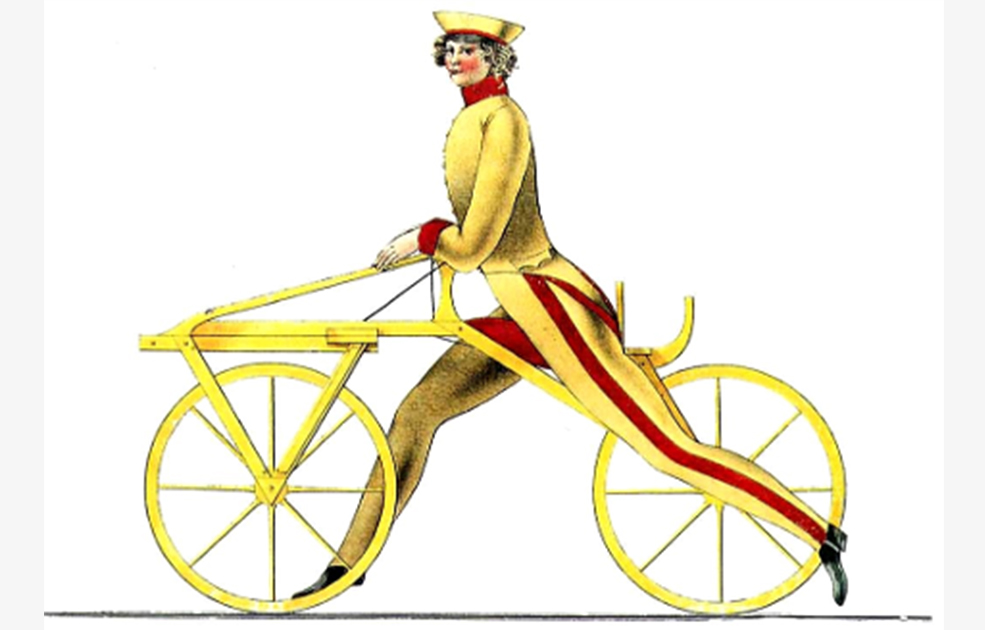
I was not surprised. I never considered the descendants of what German baron named Karl von Drais created in 1817 to be safe means for human transportation – a steerable, two-wheeled running machine.
Known by many names, including the “velocipede,” the “hobby-horse,” and the “draisine” this early invention has made Drais widely acknowledged as the father of the bicycle. But the bicycle as we know it today evolved in the 19th century thanks to the work of other different inventors.
Beginning in the 1860s, several numerous French inventors including Pierre Lallement, Pierre Michaux and Ernest Michaux developed prototypes with pedals attached to the front wheel. These were the first machines to be called “bicycles,” but they were also known as “boneshakers” for their rough ride.
By the early 1870s, bicycle technology and usage had come into its own. The crude boneshaker, based on wooden technology carriage, was replaced by the elegant “ordinary” bicycle. Hollow steel tubular frames and forks, quality ball bearings, tension-spoked wheels, steel rims, solid rubber tires, and standardized parts became common.
These bikes, while awkward to ride, were tested by the military for dispatch riders and scouts during the Franco-Prussian War of 1870-71.
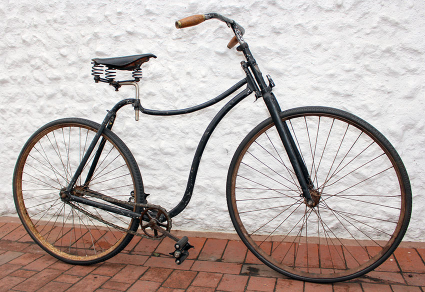
Development progressed in Great Britain and even in the United States, where technological advances included a chain-driven system that allowed for a more stable riding platform. English inventor John Kemp Starley built on this development, and produced the world’s first successful “safety bicycle,” which was dubbed the “Rover.” Released in 1885, its design would be recognizable even today. It featured equally sized front and back wheels, with the front being steerable and a chain drive to the rear wheel.
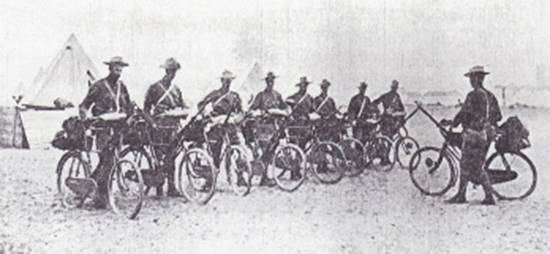
This bike design caught on during the 1890s and many military thinkers saw its potential. Cavalry on wheels was cheaper, safer and swifter than horses.
The Rover bicycle had its first real baptism of fire in the Second Anglo-Boer War. (1899-1902). Thereafter almost every army in the world had a bicycle unit.
* * *
Today we live in a world that is overwhelmed by the use of contraptions, all itinerations of John Kemp Starley’s “safety bicycle.” Most of them are safe to ride, but only over suitable terrain and while strictly observing certain rules. But, unfortunately, gone are the days when its users respect the rules of the bicycle cult.
Residents of Amsterdam in Holland, and Copenhagen in Denmark, carefully observe the rules because the authorities strictly enforce the law. In Montreal, Canada, and Budapest, Hungary, bikers are “cavaliers” about rules: they often ignore red traffic-lights, don’t respect stop-signs and invade pedestrian areas because they know they will seldom be penalized. I suspect that there are more “cavalier” riders in the world than those who carefully respect the law.
While I fully support the movement of cyclists who are working to protect our environment by getting additional cars off the road, I feel there is a need for cyclists, like motorists, to be held more accountable by law enforcement if they do not abide by the rules of the road. We need cyclists to feel safe while riding their bikes, but we also need cyclists to show respect toward pedestrians and motorists.
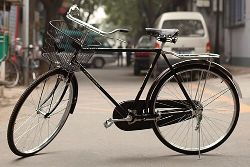
The most popular bicycle model – and most popular vehicle of any kind in the world – is the Chinese Flying Pigeon, with about 500 million produced.


Very nice…..most enjoyable read.
Hi, interesting article, as usual. Congrats.
One thing I don’t agree with, though: it may be faster than a horse in every-day use on well maintained or paved roads, especially downhill, but I doubt it could keep up with a trusty steed cross-country or uphill — and it can’t jump over ditches, fences or fallen trees.
We couldn’t agree more about the need for cyclists to behave responsibly and respect the rights of pedestrians. Here in Toulouse with its narrow streets and narrower pavements there is constant danger for those of us walking the streets from selfish bike riders who occupy the pavements with scant regard for others.
Fine the buggers heavily, otherwise these two-wheeled fiends will never heed.
Kevin and Cristina